



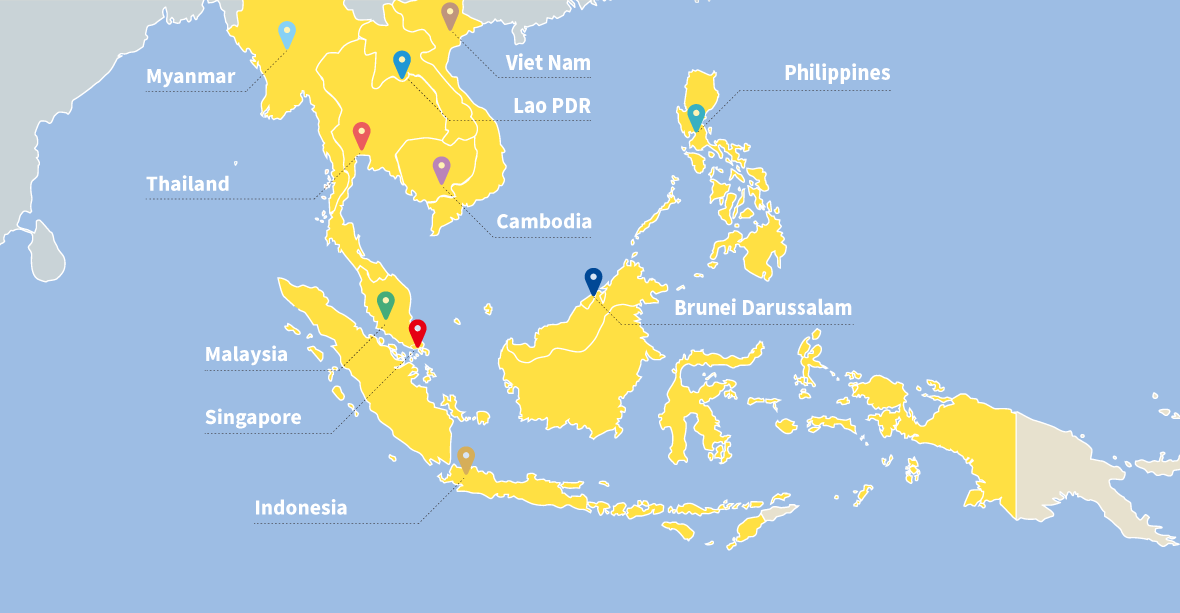
 Brunei Darussalam
 Cambodia
 Indonesia
 Lao PDR
 Malaysia
 Myanmar
 Philippines
 Singapore
 Thailand
 Viet Nam
With the need for joint response to rapid changes in the global world, such as the outbreak of Viet Nam War and the communist expansion in Indochina, the Association of Southeast Asian Nations, or ASEAN, was established on August 8, 1967, with the signing of the ASEAN Declaration (Bangkok Declaration) by the Founding Fathers of ASEAN, namely Indonesia, Malaysia, Philippines, Singapore and Thailand.
660 million
4.48 million ㎢
USD 3,173 trillion
USD 3,560 trillion (export: USD 1,849 trillion; import: USD 1,711 trillion)
※ Source: Population, area, GDP, trade volume (World Bank, IMF)
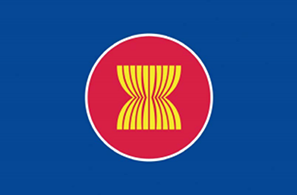 The ASEAN emblem represents a stable, peaceful, united and dynamic ASEAN. The colors of the flag—blue, red, white and yellow—represent the main colors of the flags of all the ASEAN Member States. The blue represents peace and stability. Red depicts courage and dynamism, white shows purity and yellow symbolizes prosperity.
※ France and Italy approved as development partners during the 53rd ASEAN Foreign Ministers' Meeting in September 2020.
A Concert of Southeast Asian Nations; a Partnership in Dynamic Development; a Community of Caring Societies; and an Outward-Looking ASEAN
 KOREA FOUNDATION