

본문바로가기

KFKOREA FOUNDATION

SEARCH
search closed

Brunei Darussalam

Brunei
Brunei Darussalam
Brunei Flag
Flag

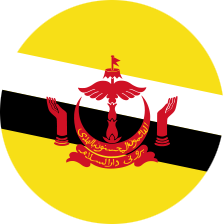
The flag of Negara Brunei Darussalam has been in use since 1906 when Brunei became a British protectorate, following the signing of an agreement between Brunei and Great Britain. The flag has a yellow background cut by black and white diagonal stripes from the top left to the bottom right corners. The colors yellow, white, and black represent the signatories of the agreement, who are the Sultan of Brunei, Pengiran Bendahara and Pengiran Pemancha, respectively. The emblem was superimposed in the center of the flag in 1959, after the promulgation of the Constitution, finalizing the flag that is being used until present.

Emblem

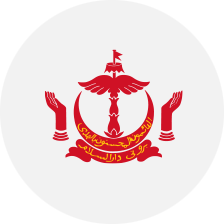
The flag and the Royal umbrella placed at the top of the emblem represents the Sultan of Brunei, its national leader. The four feathers on the wings symbolize protection of justice, tranquility, prosperity and peace. On the sides, the upturned hands indicate the government's duty to promote the welfare, peace, and prosperity of the people. The crescent is a symbol of Islam, the state religion of Brunei. The lettering inscribed inside the crescent reads "Always render service with God's guidance.” The banner on the lowest part of the emblem reads the state's name "Negara Brunei Darussalam," literally translated to “Brunei, the Abode of Peace.”
Brunei Flag
Brunei Capital
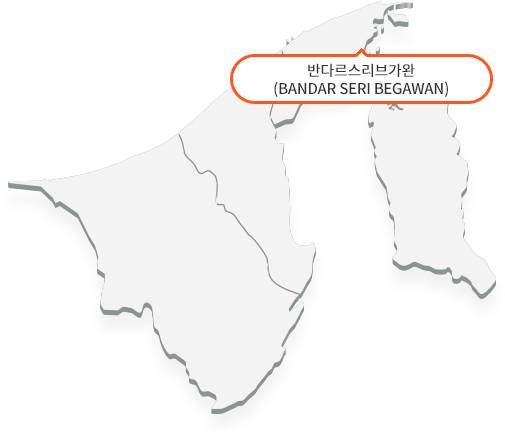
Capital : Bandar Seri Begawan

Bandar Seri Begawan (※ Used to be called "Brunei Town" before it was named after "Seri Begawan," a part of the royal title of a Sultan of Brunei in 1970.
Bandar refers to "town," and Seri Begawan refers to "aura of the gods.")

  • Population

    440,000
    (2018, IMF)

  • Area

    5,765km²
    (1/2 of Gyeonggi-do Province)

  • Time zone

    GMT+8

  • Official name

    Negara Brunei Darussalam
    ※ Literal translation: "Abode of Peace"

  • Location

    Lies on the northwest coast of the island of Borneo. The land is divided into two by the Malaysian state of Sarawak (4°2'-5°3' north latitude, 114°4'-115°2' east longitude)

  • Language(s)

    Malay (official language), English

  • Ethnic groups

    Malay 65%, Chinese 11%, Others 24% (2017, Brunei Economic Development Board)

  • Religion(s)

    Muslim (freedom of religion is guaranteed, but propagation is prohibited)

  • Area

    5,765km² (1/2 of Gyeonggi-do Province)

    • Farmland: 5%, forest (tropical forest): 80.6%
    • The country is divided into four districts, consisting of Brunei-Muara, Belait, Tutong and Temburong.
  • Climate

    Tropical climate with high temperature and humidity

    • Average max. temperature : 34°C
    • Average min. temperature : 22°C
    • Average annual rainfall : 3,300 mm

Brunei Darussalam Timeline

  • 1405
    • Foundation of the Sultanate of Brunei Possessed a great part of the eastern region of Malaysia of today
  • 16th Century
    • The Golden Age of the Sultanate of Brunei Expanded influence to the northern part of the island of Borneo and the southern part of the Philippines
  • 17th Century
    • The Netherlands controlled the eastern and southern parts of the Borneo Island
  • 18th and 19th Century
    • The British took control of the southern part of the Borneo Island
  • 1847
    • Signed the Treaty of Friendship and Commerce with the British Ceded most of the territory of the states of Sabah and Sarawak to the British, declined as a small nation
  • 1888
    • Signed the "Treaty of Protection," becoming a British protected state
  • 1906
    • Control of the British Resident
  • 1942
    • Japanese occupation
  • 1959
    • A new constitution written declaring Brunei a self-governing state Foreign affairs, security, and defence remained the responsibility of the United Kingdom
      ※ Dispatched a British High Commissioner
  • 1962
    • Rebellion erupted for the inclusion in the Malaysian Federation Suppressed with the support of the United Kingdom Declaration of emergency (political dissolution and constitution suspension)
  • 1968
    • Coronation of Hassanal Bolkiah as the 29th Sultan and Yang di-Pertuan of Brunei (Aug. 1)
  • 1971
    • Amendment of the treaty with the British, becoming a completely self-autonomous country
  • 1984
    • - Gained complete independence from the British (Jan. 1)
    • - Joined ASEAN (Jan. 7)
    • - Joined the Organisation of Islamic Cooperation (OIC) (Jan. 16)
    • - Joined the United Nations as the 159th member
  • 1989
    • Joined the Asia-Pacific Economic Cooperation (APEC)
  • 1996
    • Joined the Asia-Europe Meeting (ASEM)
  • 1998
    • Sultan proclaimed Crown Prince and eldest son Al-Muhtadee Billah heir to the Bruneian throne
  • 2000
    • Held the APEC Economic Leaders' Meeting
  • 2001
    • Held the ASEAN Summit and ASEAN Plus Three Summit
  • 2007
    • Announced the Brunei Vision 2035
  • 2013
    • Held the ASEAN Plus Three Summit
  • 2018
    • Accepted the role as ASEAN-ROK dialogue coordinator


TipUseful information
on the culture of Brunei Darussalam
Customs
  • Do not use your index finger to point a person or object. Instead, use your right fist with the thumb pointing up.
  • Crossing legs is considered impolite. Keep your feet flat on the floor when seated.
  • It is customary to bring your right hand to the chest after shaking hands, but it is not quite expected from foreigners. Brunei is an Islamic country, but Bruneians do not hug like the Arab world.
  • According to the doctrines of Islam, Muslims do not consume pork and alcoholic drinks. Chicken and beef may be consumed only when they are halal meat (meat slaughtered in a prescribed method per Islamic law).
  • Drinking alcoholic beverages in public areas is illegal. Liquors are sold to non-Muslim individual consumers.
Titles
  • Instead of using Mr. or Mrs. before a person's name, Titles Pengiran, Pehin, Dato given by the national Sultan and Haji, Awang are used.
  • Meanings of the titles
    • Pengiran: Title given to the Royal Family or the firstborn of a powerful clan who participated in the supreme decision process of the Brunei Kingdom in the past.
      ※ Abbreviation : Pg
    • Pehin : The highest title an ordinary person can get. They are usually used as Dato or Pehin Dato. Their wives are given the Datin title.
      ※ Those given the Pehin title receive a certain amount of pension from the government.
    • Dato' (male); Datin (female) : The first title a person who has been given a national merit receives. The wife of a Dato' is called Datin.
    • Haji (male); Hajah (female) : Refers to people who had successfully completed the Hajj to Mecca. Muslims consider this very proud, so even when they are given another title, they would use it together with this title.
      ※ Abbreviation: Hj (male), Hjh (female) Other titles include Awang (male) and Dayang (female) given to ordinary people.
  • People who are given a title would often combine it with another title given by the national Sultan.
    Paduka, Seri, Orang Kaya, Di-Gadong, etc.
  • bin (male) and binte (female) that come in between names indicate that the person is the child of the father whose name comes after the aforementioned titles.
    Example: Pg Hj Mashor bin Pg Hj Ahmad (Father Ahmad's son Mashor)
    ※ Abbreviation: bin-b, binte-bte
  • The father's name comes after the given name, so Malay households do not have a permanent surname. They do not have the culture of females using their spouse’s names after they get married.