

본문바로가기

KFKOREA FOUNDATION

SEARCH
search closed

Malaysia

Myanmar Flag
Myanmar
Myanmar Flag
Flag

The current flag of Myanmar was adopted in October 2010, along with implementing changes to the country's name from the Union of Myanmar to the Republic of the Union of Myanmar. The yellow, green, and red horizontal stripes represent solidarity, peace, and courage, respectively. The white star on the middle stands for unity.

Emblem

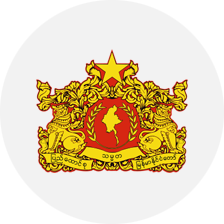
The State Seal of Myanmar has a map of Myanmar in the center surrounded by olive branches. On the top of the emblem is a star, symbolizing eternity of the united federal. Beside the branches are chinthe, the mythical lions, seated facing outwards. The scroll on the bottom reads "The Republic of the Union of Myanmar" in Burmese.
Myanmar Flag
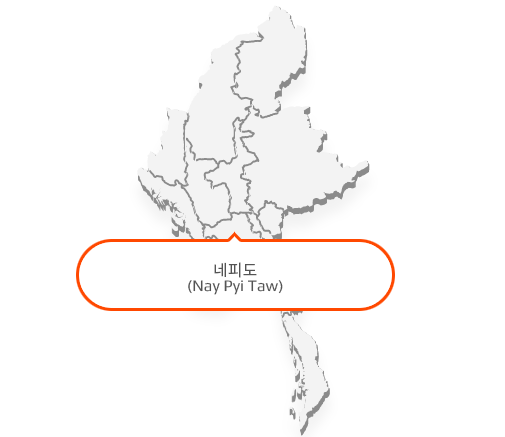
Myanmar Map
Capital : Nay Pyi Taw
  • Population

    52.83 million
    (IMF)

  • Area

    676,577㎢
    (3 times larger than the Korean Peninsula)

  • Time zone

    GMT+6:30

  • Official name

    The Republic of the Union of Myanmar

  • Location

    Northwest of the Indochina Peninsula (bordered with Thailand, Laos, China, India, and Bangladesh)

  • Independence

    January 4, 1948 (Independence from the British)

  • Ethnic groups

    135 ethnic groups, including Bamar (68%), Shan, Kachin, Kayin, Mon, Chin, and Rakhine
    ※ According to the official announcement of the Myanmar government

  • Climate

    Tropical monsoon climate; Strong division between rainy season (May-Oct) and dry season The average annual temperature is 27.4°C and the average annual rainfall is 2,513 mm.

  • Religion(s)

    Buddhist (88%), Christian (6%), Muslim (4%), folk religion (1%), Hindu (0.5%), etc.

  • Language(s)

    Myanmar language (official language) and other minority languages

Myanmar Timeline

  • 1947
    • Establishment of the Burma Independence Act
  • 1948
    • Independence Ruling of the loose federation by Anti-Fascist People's Freedom League (AFPFL)
  • 1958
    • Legal ruling by the army for 18 months until the general elections
  • 1960
    • General elections (victory of the Union Party led by Nu)
  • 1962
    • Ruling of Ne Win after staging a coup by military officers and collapsing Nu's government
  • 1974
    • Amendment of the constitution (military-based ruling by the Burma Socialist Program Party (BSPP))
  • 1988
    • Anti-government protests by students; returning of Aung San Suu Kyi; founding of the National League for Democracy (NLD); resignation of Ne Win; coup by the armed forces and abolition of the constitution
  • 1989
    • General assembly (victory of NLD) and the military's refusal of turning over the government
  • 1997
    • Joined ASEAN
  • 2003
    • Announcement of a seven-step "roadmap to democracy" (amendment of the constitution, forming of the National Convention, assembly, moving of the government, etc.)
  • 2006
    • Relocation of the capital city from Yangon to Nay Pyi Taw.
  • 2007
    • Saffron Revolution (pro-democracy protest by monks)
  • 2008
    • Devastation of the nation by Cyclone Nargis, referendum for amendment of the constitution
  • 2010
    • Held the general election without the participation of the NLD; winning of the Union Solidarity and Development Party (USDP)
  • 2011
    • Assembly of the Burmese Parliament; turnover to the people-elected government and inauguration of President Thein Sein
  • 2015
    • General election and winning of the NLD
  • 2016
    • Establishment of the NLD government


TipUseful information
on the culture of Myanmar
Culture
  • Myanmar of the ancient time had close contact with India and China (mostly Yunnan). It was especially influenced by Indian culture in the areas of religion, literature, construction, craftwork, and theater. Cultural impact from China is relatively weak than that from India.
  • In particular, India's influence is significant in the Buddhist culture. Meanwhile, it can be viewed that the Hindu culture did not have great influence.
    ※ Buddhism of Myanmar is Theravada, which has been passed down from India and Sri Lanka through the Mon people in southern Myanmar in the 5th century. It was spread throughout Myanmar during the time of the Pagan Kingdom in the 11th century.
  • The western culture was introduced with the colonization by the British. However, after independence, Myanmar established the Ministry of Culture to protect and promote the traditional cultures of the nation.
Attire
  • Formal attire is not preferred and worn only for formal events because of the scorching climate. The temperature is similar throughout the year, so seasonal clothing is not needed.
  • Longyi, a skirt-like attire, is worn by everyone including the national leader for all occasions, from everyday life to official events.
  • It is wrapped around the waist, running to the ankles. The wrapping method is different for men and women.
  • Slippers on bare feet are worn instead of shoes.
Festivals
  • Festivals are part of Burmese life. Most festivals are deeply related to Buddhism.
  • The main festivals of Myanmar are as follows:
    • → Tabodwe (Feb–Mar) : In hopes of a good harvest, food is prepared by a mix of glutinous rice, sesame oil, peanut, ginger, and coconut. Relatives and neighbors are invited for a party.
    • → Tabaung (Mar) : Pagoda festivals are held in temples with competitions for looming monk clothing.
    • → Thingyan (mid-April) : As the greatest water festival of Myanmar, it is held right before the Myanmar New Year. Each household wash the face of a Buddha image with scented water and sprinkle water to pedestrians wishing luck. It is held in similar periods of other Southeast Asian water festivals, such as the Songkran in Thailand.
    • → Kason (May) : An occasion to celebrate the day Lord Buddha was born, achieved enlightenment, and entered Parinirvana in May. Burmese celebrate this day by women watering the scared Bodhi tree.
    • → Waso (Jul) : In memory of the day the Buddha preaches his first sermon, teenagers pick flowers and lay them in front of Buddha images, while monks resolve to devote to Buddha's teachings. During this period, marriage and changing of accommodation during the period are not encouraged.
    • → Thadingyut (Oct) : Buddha descends from the sky after being enlightened by his mother in heaven during the three Lenten months. People welcome him with bright lights.
Customs
  • Giving items or offering food with the left hand is considered disrespectful.
  • With the influence of Buddhism and reverence for animals and spiritual beings, many people choose not to consume beef, and usually prefer chicken.
Language
  • The Myanmar language is generally used after it has been adopted as the official language by the constitution in 2008. States where minority groups reside, such as Rakhine, Shan, and Kachin also use their unique minority languages.