

본문바로가기

KFKOREA FOUNDATION

SEARCH
search closed

Philippines

The Philippines Flag
Philippines
Philippines Flag
Flag

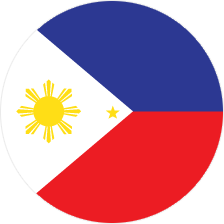
The current Philippine flag was designed by Philippine's national hero Emilio Aguinaldo, formally unfurled for the first time during the Proclamation of Philippine Independence from Spain on June 12, 1898. The white of the flag stands for liberty, equality, and fraternity; blue for peace, truth, and justice; and red for patriotism and valor. In the state of war, the blue and red switch places. The sun inside the triangle represents freedom, while the eight rays of sunlight symbolize the first eight provinces of the Philippines that rebelled against Spain's martial law. The three stars represent the three main island groups of the Philippines, which are Luzon, Visayas, and Mindanao.

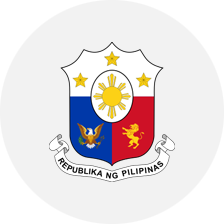
Emblem

The coat of arms of the Philippines has a shining sun and three stars. The meanings of the colors white, blue, and red are the same to those on the flag. The eagle and lion each symbolize the history of colonization under the United States and Spain. Official vehicles of the Philippine government use the coat of arms without the eagle and lion.
Philippines Flag
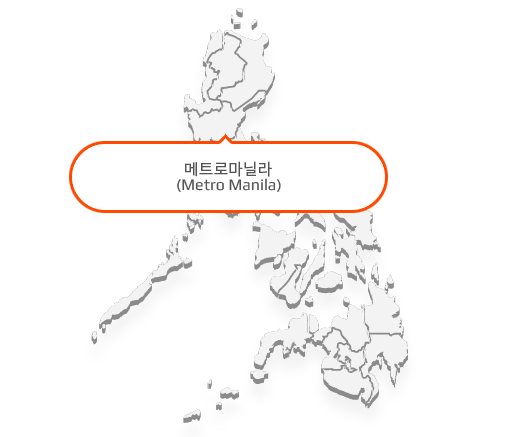
Philippines Map
Capital : Metro Manila
  • Population

    170 million
    (2018, IMF)

  • Area

    300,400㎢
    (1.3 times larger than the Korean Peninsula)

    ※ Formed of 7,107 islands; 65% of the nation is mountainous

  • Time zone

    GMT+8

  • Official name

    Republic of the Philippines

  • Ethnic groups

    Malay descents form the majority; Chinese, American, and Spanish backgrounds are common

  • Climate

    Subtropical climate with high temperatures and high humidity

  • Religion(s)

    Roman Catholic (83%), Christian (9%), Muslim (5%), Buddhist and others (3%)

  • Language(s)

    English and Tagalog

Philippines Timeline

  • 1565
    • Spanish colonization
  • 1898
    • American colonization
  • 1942
    • Japanese occupation
  • 1945
    • Surrender of Japan, recolonization by the US
  • 1946
    • Independence from the United States
      Ruling of President Roxas
  • 1961
    • Ruling of President Macapagal
  • 1965
    • Election of President Marcos
  • 1969
    • Reelection of President Marcos
  • 1972
    • Declaration of martial law by Marcos
  • 1983
    • Assassination of Senator Benigno "Ninoy" Aquino Jr.
  • 1986
    • People Power I removed Marcos from power
      Ruling of President Corazon Aquino
  • 1992
    • Ruling of President Ramos
  • 1998
    • Ruling of President Estrada
  • 2001
    • People Power II removed Estrada from power
      Arroyo succeeded the presidential position
  • 2004
    • Winning of Arroyo at the presidential election
  • 2010
    • Ruling of President Aquino
  • 2016
    • Ruling of President Duterte


TipUseful information
on the culture of the Philippines
Religion
  • 83% of Filipinos are Roman Catholic, while 9% are Christian, 5% are Muslim, and 3% is comprised of Buddhists and other religions.
  • Christianity is especially strong in Luzon and Islam in Mindanao. In the highlands of the northern region, many maintain their animistic beliefs.
  • Roman Catholic: It arrived with the landing of Magellan in 1521, but spread widely in the late 16th century and settled among the people in the mid-17th century. Philippine's Catholicism is blended with the nation's traditional animistic practices and festivals, which resulted in a passionate faith for the new religion.
  • Christianity: It was spread by the Americans since 1899. The Bible was translated into different languages, which was prohibited by Catholicism then, and actively engaged in education and medical fields.
  • Islam: It was spread starting from the Sulu Archipelago to Mindanao in 1380. It temporarily influenced up to the south of Luzon in the late 16th century, but with Spain's Catholic policies, it settled only in the region of Mindanao.
Women
  • As a nation that has had two female presidents ruling the country, namely Corazon Aquino (the mother of former President Aquino) and Arroyo, Philippine society has relatively stronger women's rights.
  • Women take up 51.1% of high-ranking positions in Philippine corporations (world average: 34%), and the 18th Congress has seven female senators, taking up 29.2% of the whole congress.
  • According to the Gender Gap Report released by the World Economic Forum in 2018, women's status in the Philippines was the 8th highest among 149 countries.
  • Traditionally, land (property) was handed down to sons for cultivation, while daughters were given education. This has made higher literacy levels for women than for men, resulting in women's predomination in employment and society.