

본문바로가기

KFKOREA FOUNDATION

SEARCH
search closed

Thailand

Thailand Flag
Thailand
Thailand Flag
Flag

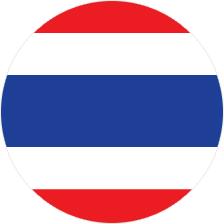
The current flag of Thailand was adopted in 1917, according to the royal decree issued by Rama VI, the sixth king of the current Chakri dynasty. The flag is composed of three colors, including blue, white, and red. Blue stands for the monarchy, white for Buddhism, and red for the blood of the people. They represent the monarchy, Buddhism, and the people that form Thailand, meaning to protect the king with the blood of the people with a Buddhist spirit.

Emblem

The emblem of Thailand is an image of the mythical bird called "Garuda," the symbol of the god of prosperity and a legendary creature that transcend time and space. It is worshiped as a god that protects the nation and the royal family in Thailand.
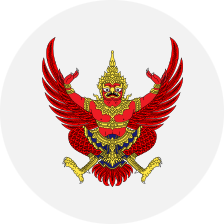
Thailand Emblem
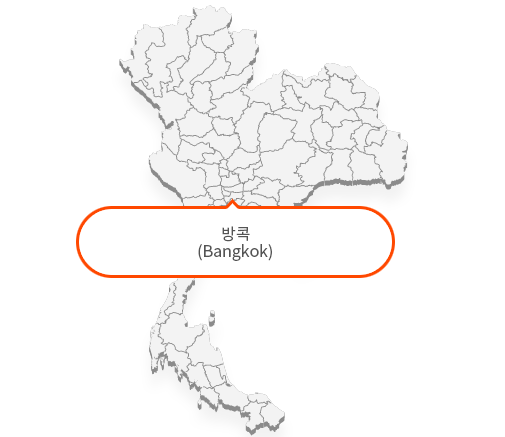
Thailand Map
Capital : Bangkok
  • Population

    69.18 million
    (2018, IMF)

  • Area

    513,000㎢
    (2.3 times larger than the Korean Peninsula)

  • Time zone

    GMT+7

  • Official name

    Kingdom of Thailand

  • Politics

    Constitutional monarchy

  • Governance

    Parliamentary cabinet system

  • Ethnic groups

    Thai 85%, Chinese 12%, Malay 2%, etc.

  • Religion(s)

    Buddhist 95%, Muslim 4%, Christian 1%

  • Language(s)

    Thai (official language), Chinese, Malay

  • Main resources

    Natural rubber, tapioca, tin, tungsten, antimony, and natural gas

  • Climate

    Tropical climate with high temperatures and high humidity; 3 distinctive seasons
    ※ March-May: High temperatures; June-October: Rainy season (December for southern regions); November-February: Relatively cool

    • Average annual temperature : 28℃ (maximum: 32.5℃, minimum: 23.7℃)
    • Average annual rainfall : 1,600 mm
    • Average annual humidity : 79% (maximum 94%, minimum 60%)


TipUseful information
on the culture of Thailand
High respect toward the national king
  • Thailand's governance is traditionally based on the doctrine of Buddhism, which the king who governs the people like a dad taking care of a child is highly respected as an ideal king. Since 1932, after the nation's governance system changed from absolute monarchy to permanent military rule, the king did not directly engage politics anymore, but people's respect toward the king and the royal family is still high.
  • In particular, the late King Phumiphon, or Rama IX, went around the nation for decades looking after the people and finding ways to improve the quality of lives through Royal development projects. His devotion was the basis of people's unconditional support and respect that realized national unity.
Love toward the people and the nation
  • In the 19th century, when Britain and France were expanding their influence in the peripheral regions of Thailand, Rama V designed modernization reforms. As part of the project, in 1868, Rama V abolished the slave tradition, guaranteed a free status to the people, had everyone speak Tai (a group of languages spread across the Southeast Asia after the Mongolian attack in the 12th century and changed over time) regardless of ethnicity groups, and granted everyone living in Thailand's territory Sanchat Thai, or Thai nationality.
  • In 1913, the Thai government enacted the Thai Nationality Act that granted Thai nationality to anyone who was born and raised in Thailand.
  • Thailand is proud for being the only nation that maintained independence in Asia despite the threatening attempts for invasion by peripheral nations. The people also have strong affection toward the country and the Royal family.
Values based on Buddhism
  • Thailand strongly believes in the Buddhist ideas of karma, charity, and samsara. The people greatly believe that the good act you do will bring happiness in this life, but other acts that go against the Buddhist doctrine will bring bad luck to the next life.
  • A person with a high social status and respected as a kind person is thought to have made a lot of good actions in the past life. In this sense, socioeconomic inequality tends to be seen as a result of karma.
  • Buddhist temples traditionally served as educational institutions for Thai people. Through the teachings of Buddhism, people learned the social norms, ethics, and their roles as part of society.
Features of Thailand's Buddhism
  • Thailand believes in Theravada, which the monks value the practice of extremely strict disciplines and reaching the state of nirvana. Thailand's belief for karma and samsara serves as an ethical standard encouraging people to practice kind actions and refrain from negative acts.
  • Men customarily leave the household once in a lifetime for one to three months to serve as a monk. They reflect on their past mistakes and follow the teachings of Buddhism to become a kind person. The Thai language classifies men who have not completed their term as a monk as khon dip, or raw men, and those who did complete their term as khon suk, or ripe men. The term is considered as a ritual for boys becoming men.
  • Thai believe that their sons leaving the house to serve as monks is an act of building a good deed. Sons regard it as a way of giving back their parents all the care they have been receiving (especially for mothers who cannot leave the house to become monks). In Thailand, there are about 40,000 temples and 290,000 monks. Buddha images are placed in temples, households, offices, and even stores, showing the deep belief in the religion. Buddha statues and monks are considered sacred and receive utmost respect. It is prohibited to blaspheme against Buddha.
Customs
  • Thai's way of greeting with a slight bow with the palms pressed together in front of the face is referred to as the wai. The custom shows Thai's well-mannered behavior and courteous culture. The hands are held higher in relation to the status or position of the person receiving the wai.
  • The people have strong belief and respect toward the Royal family, so verbally or physically insulting the Royal family is strictly prohibited, even for foreigners. When the Royal anthem is played in cinemas, the audience should stand up and show their respects. At 8 AM and 6 PM when the national anthem is played, people should stop what they are doing and stand straight until the anthem is over.
  • The people have strong belief and respect toward the Royal family, so verbally or physically insulting the Royal family is strictly prohibited, even for foreigners. When the Royal anthem is played in cinemas, the audience should stand up and show their respects. At 8 AM and 6 PM when the national anthem is played, people should stop what they are doing and stand straight until the anthem is over.
  • Especially, when seated, the tip of the toes should not face a Buddha's statue or image.
  • Thailand did not use surnames until early 20th century because of Buddhism traditions. The use of surnames was first implemented in 1913. Until today, it is preferred to call people by their first names or nicknames instead of surnames. For example, Prime Minister Prayut Chan-o-cha is called Prime Minister Prayut, rather than his surname.